Forage yield and morphological characteristics of sorghum and pearl millet genotypes under warm–humid conditions
DOI:
https://doi.org/10.29059/rmic.v1i1.6Keywords:
Biomass production, total dry matter, C4 grassesAbstract
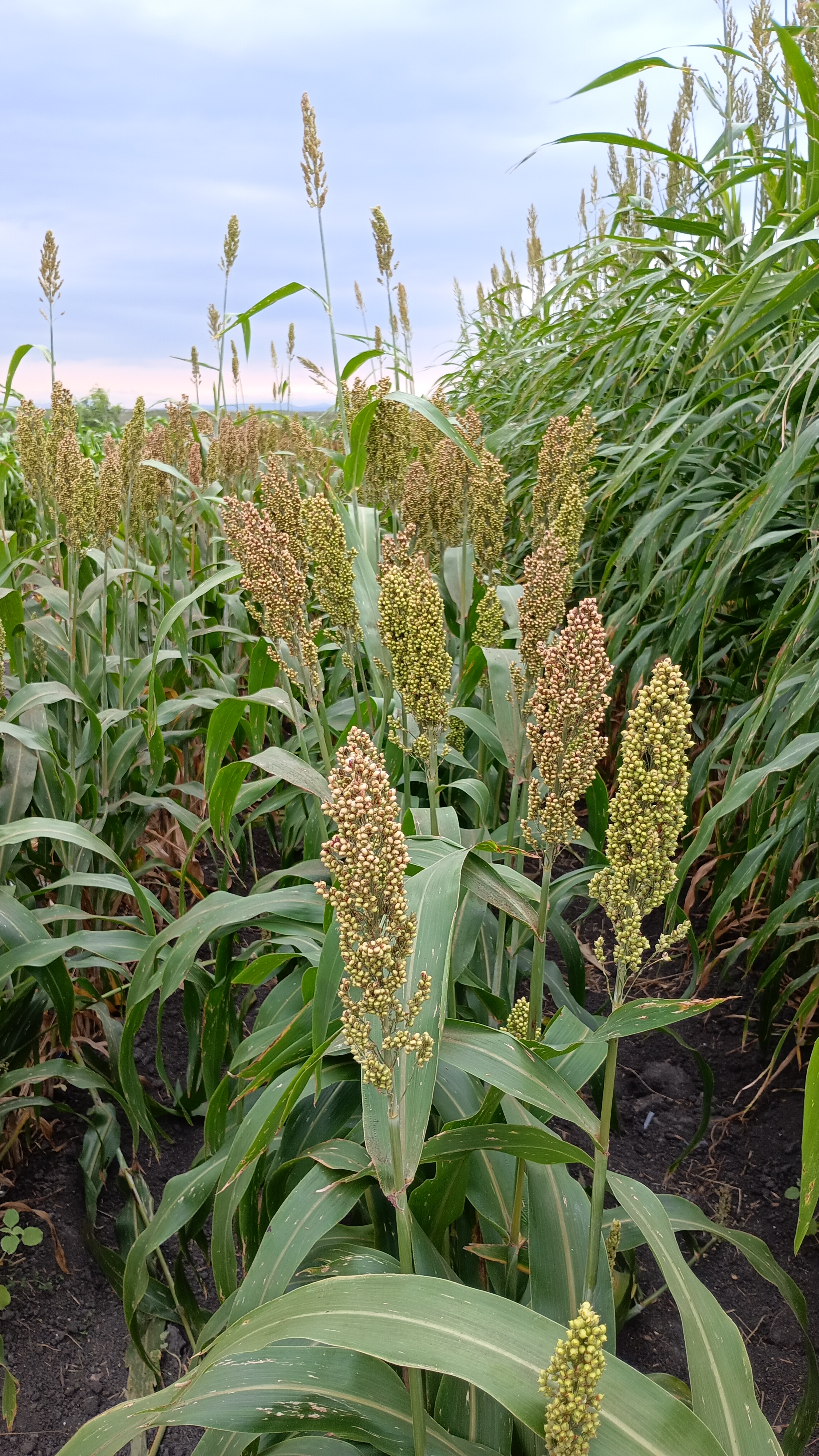
Sorghum and pearl millet are important forage alternatives in warm sub-humid environments due to their adaptation and capacity to produce biomass. The objective of the study was to evaluate forage yield and the morphological composition of sorghum and pearl millet genotypes under warm sub-humid conditions. The experiment was conducted under rainfed conditions with supplemental irrigation, evaluating 12 sorghum genotypes and one pearl millet genotype. Plant height and green matter yield (TGM) and dry matter (TDM) yield were measured, as well as the proportions of leaf, stem, panicle, and dead material. The statistical analysis was performed using a randomized complete block design with four replications (Tukey; α=0.05). Genotypes 197-1 and 197-1-1 recorded the greatest heights (≈ 295 cm) and the highest TGM (63.9–67.6 t ha-1) and TDM (13.9–15.3 t ha-1) yields, with a dominance of stem (>55 %). In contrast, pearl millet and Procónsul showed the lowest heights (142-148 cm) and the lowest yields (10.3-19.8 t ha-1 of TGM; 2.5-5.4 t ha-1 of TDM), traits commonly observed in reduced-height and dual-purpose materials. Genotypes such as Fortuna and 195-2 showed a more balanced composition, with a higher proportion of leaf (≈36-38 %) and panicle (≈23-30 %), suggesting greater quality potential. The results indicate that tall genotypes are suitable for maximizing forage production, whereas those with a greater proportion of leaf and panicle are better suited to systems in which nutritive quality is prioritized.
References
Alix, H., Tremblay, G.F., Bélanger, G., & Bertrand, A. (2019). Forage yield, nutritive value, and ensilability of sweet pearl millet and sweet sorghum in in five Canadian ecozones. Canadian Journal of Plant Science 99(5): 745-757. https://doi.org/10.1139/cjps-2019-0031
Assefa, Y., Staggenborg S.A., & Prasad, V.P.V. (2010). Grain sorghum water requirement and responses to drought stress: A review. Crop Management 9: 1-11. https://doi.org/10.1094/CM-2010-1109-01-RV
Bean, B.W., Baumhardt, R.L., McCollum, F.T. III, & McCuistion, K. C. (2013). Comparison of sorghum classes for grain and forage yield and forage nutritive value. Field Crops Research, 142: 20-26. https://doi.org/10.1016/j.fcr.2012.11.014
Bhattarai B., Singh S., West C.P., Ritchie G.L., & Trostle C.L., 2020. Water depletion pattern and water use efficiency of forage sorghum, pearl millet, and corn under water limiting condition. Agric. Water Manag. 238: 106206. https://doi.org/10.1016/j.agwat.2020.106206
Bhattarai, B., Singh, S., West, C. P., & Saini, R. (2019). Forage potential of pearl millet and forage sorghum alternate to corn in water limiting condition of Texas High Plains - A review. Crop Forage Turfgrass Management, 5: 1–12. https://acsess.onlinelibrary.wiley.com/doi/epdf/10.2134/cftm2019.08.0058
Chaudhary, D.P., Saini, R.K., Maurya, B.K., Sharma, M., Kumar, R., Sen, R., & Singh, S.K. (2018). Study of genetic variability and fodder yield components in forage sorghum (Sorghum bicolor L. Moench). Bulletin of Environment, Pharmacology and Life Sciences 7(2): 5-9. http://bepls.com/jan_2018/2.pdf bepls.com
Cruz, A., Saini, D.K., Aviles, D., Norris, A., & Jagadish, S.V.K. (2025). Chapter Three – Sorghum and pearl millet as sustainable alternative forage options for water limited environments: Opportunities and challenges. Advances in Agronomy 189: 137-192. https://doi.org/10.1016/bs.agron.2024.08.001
Cuevas-Reyes, V., Loaiza-Meza, A., Gutiérrez-Gutiérrez, O., Borja-Bravo, M., & Rosales Nieto, C.A. (2024). Tipología de productor y efectos indirectos del cambio climático en la ganadería bovina en Sinaloa. Revista Mexicana de Ciencias Pecuarias 15: 555-569. https://doi.org/10.22319/rmcp.v15i3.6529
Daduwal, H.S., Bhardwaj, R., & Srivastava R.K. (2024). Pearl millet is a promising fodder crop for changing climate: a review. Theoretical and Applied Genetics 137: 169. https://doi.org/10.1007/s00122-024-04671-4
Fardin, F., Sani, B., Moaveni, P., Afsharmanesh, G., & Mozafari, H. (2023). Nutritional value and agronomic traits of forage sorghum under drought stress. Biocatalysis and Agricultural Biotechnology 48: 102624. https://doi.org/10.1016/j.bcab.2023.102624
Farooq, M., Hussain, M., Ul-Allah, S., & Siddique, K.H.M. (2019). Physiological and agronomic approaches for improving water-use efficiency in crop plants. Agricultural Water Management 219: 95–108. https://doi.org/10.1016/j.agwat.2019.04.010
Garay-Martínez, J.R., Godina-Rodríguez, J.E., Hernández-Rodríguez, B., Maldonado-Torres, A., López-Cantú, D.G., & Joaquín-Cancino, S. (2024). Caracterización de unidades de producción pecuaria en Aldama, Tamaulipas, México: productores, hato y alimentación animal. Ecosistemas y Recursos Agropecuarios, 11: e4091. https://doi.org/10.19136/era.a11nIV.4091
Getachew, G., Putnam, D., De Ben, C.M., & De Peters, E.J. (2016). Potential of sorghum as an alternative to corn forage. American Journal of Plant Sciences 07:1106-1121. https://doi.org/10.4236/ajps.2016.77106
Guretzky, J.A., & Redfearn, D.D. (2021). Seeding rate effects on forage mass and vegetation dynamics of cool-season grass sod interseeded with sorghum-sudangrass. Agronomy 11(12): 2449. https://doi.org/10.3390/agronomy11122449
Ingrao, C., Strippoli, R., Lagioia, G., & Huisingh, D. (2023). Water scarcity in agriculture: An overview of causes, impacts and approaches for reducing the risks. Heliyon 9:1-16. https://doi.org/10.1016/j.heliyon.2023.e18507
Jahansouz, M.R., Afshar, R.K., Heidari, H., & Hashemi, M. (2014). Evaluation of yield and quality of sorghum and millet as alternative forage crops to corn under normal and deficit irrigation regimes. Jordan Journal of Agricultural Sciences, 10: 699–715. https://doi.org/10.12816/0031747
Lauriault, L.M., Schmitz, L.H., Cox, S.H., & Scholljegerdes, E.J. (2021). A comparison of pearl millet and sorghum–sudangrass pastures during the frost-prone autumn for growing beef cattle in semiarid region. Agriculture 11(6): 541. https://doi.org/10.3390/agriculture11060541
Lucio-Ruiz, F., Aranda-Lara, U., Garay-Martínez, J.R. Joaquín-Cancino, S., Estrada-Drouaillet, B., Bautista-Martínez, Y., & Limas-Martínez, A.G. (2023). Requerimiento térmico, producción y valor nutritivo de forraje de genotipos de sorgo. Revista Fitotecnia Mexicana 46(4-A): 521-528. https://doi.org/10.35196/rfm.2023.4A.521
Mekasha, A., Min, D., Bascom, N., & Vipham, J. (2022). Seeding rate effects on forage productivity and nutritive value of sorghum. Agronomy Journal 114(1): 201-215. https://doi.org/10.1002/agj2.20856
Montes, G.N., Williams, H.A., Arcos, G.C., Pecina, V.Q., Garza, M.C., Moreno T.G., & Vargas, E.V. (2014). RB-Huasteco, sorgo de grano para áreas de riego y temporal. Revista Mexicana de Ciencias Agrícolas 5:1331-1335. https://www.scielo.org.mx/pdf/remexca/v5nspe7/v5spe7a7.pdf
Ruiz V.J., & Carrillo R.J.C. (2005). Selección de cultivares forrajeros de sorgo (Sorghum bicolor) y mijo (Pennisetum americanum) por índices de eficiencia de producción y calidad. Agronomía Mesoamericana 16:153-160. https://www.redalyc.org/articulo.oa?id=43716205
SAS Institute Inc. (2009). SAS/STAT® 9.2 User’s Guide. Cary, NC: SAS Institute Inc.
Taylor, J.R.N. (2016). Millet Pearl: Overview. Encyclopedia of Food Grains (Second Edition) 1: 190-198. https://doi.org/10.1016/B978-0-12-394437-5.00011-5
Villanueva-Avalos, J.F., Vázquez-González, A., & Quero-Carrillo, A.R. (2022). Atributos agronómicos y producción de forraje en ecotipos de Cenchrus purpureus en condiciones de trópico subhúmedo. Revista Mexicana de Ciencias Agrícolas 13: 1-9. https://doi.org/10.29312/remexca.v13i27.3147
Widodo, S., Indriatama, W.M., Anggraeny, Y.N., Sholikin, M.M., Jayanegara, A., & Wahyono, T. (2025). Forage biomass and nutrient quality in brown midrib (BMR) compared to conventional sorghum: A meta-analysis approach. Journal of Advanced Veterinary and Animal Research 12(1): 157-168. http://doi.org/10.5455/javar.2025.l883
Downloads
Published
How to Cite
Issue
Section
License
Copyright (c) 2025 Revista Mexicana de Ingeniería y Ciencias

This work is licensed under a Creative Commons Attribution-NonCommercial 4.0 International License.