Forage potential of soybean (Glycine max) in monoculture and agroforestry systems with Guazuma ulmifolia and Tabebuia rosea
DOI:
https://doi.org/10.29059/rmic.v1i2.17Keywords:
Biomass production, total dry matter, nutritive valueAbstract
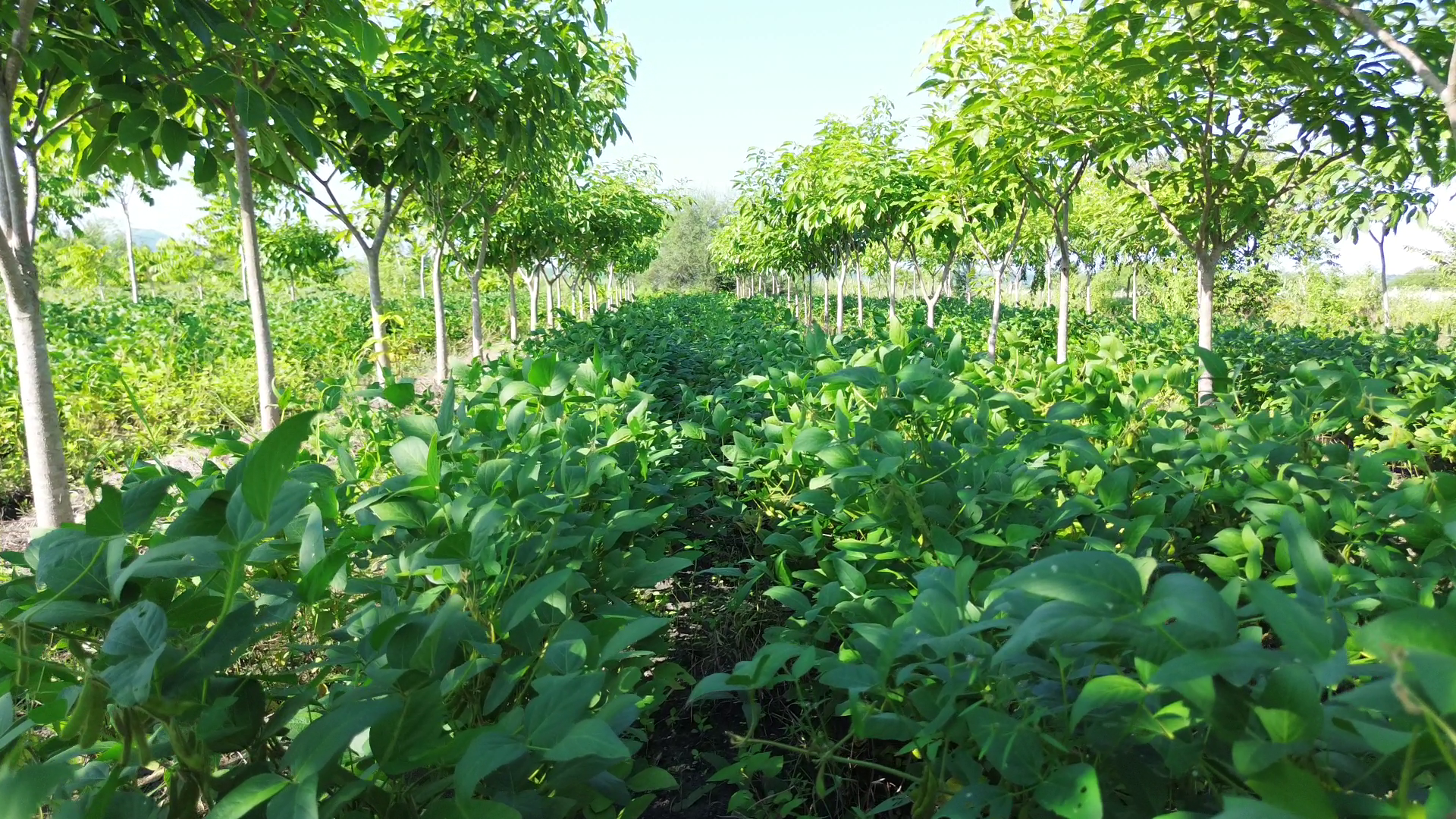
Soybean (Glycine max L.) represents a relevant forage alternative in tropical systems due to its high biomass production and protein content; however, its performance varies depending on the production system. The objective of this study was to evaluate the forage potential of soybean Huasteca 200 under monoculture and agroforestry systems with Guazuma ulmifolia and Tabebuia rosea. The experiment was conducted under rainfed conditions, comparing three production systems. Plant height, total green matter yield (TGMY), total dry matter yield (TDMY), yields by morphological components (leaf, stem, and pod), their proportions, and nutritive quality (crude protein and crude fiber) were measured. Statistical analysis was performed using a randomized complete block design, complemented by principal component analysis. Monoculture recorded the highest TGMY (23.73 t ha-1) and TDMY (6.95 t ha-1), outperforming agroforestry systems, where biomass reductions of up to 62 % were observed. However, the association with G. ulmifolia showed the highest crude protein content (164 g kg-1) and leaf proportion (68 %), indicating improved nutritive value. The T. rosea system showed lower values for both yield and quality. Multivariate analysis revealed a trade-off between forage quantity and quality. In conclusion, monoculture maximizes biomass production, while association with G. ulmifolia improves nutritive quality, suggesting its potential in agroforestry systems.
References
AOAC International. (2019). Official methods of analysis of AOAC International (21st ed.). AOAC International. https://www.aoac.org/official-methods-of-analysis-21st-edition/
Aponte, A., Valencia-Chin, E., & Beaver, J. (2015). Biomass and nutritive value of forage soybean lines (Glycine max L. Merr.) in northwestern Puerto Rico. The Journal of Agriculture of the University of Puerto Rico, 99(1), 19–36. https://doi.org/10.46429/jaupr.v99i1.2524
Buxton, D. R., & Fales, S. L. (1994). Plant environment and quality. In G. C. Fahey Jr. (Ed.), Forage quality, evaluation, and utilization (pp. 155–199). ASA-CSSA-SSSA. https://doi.org/10.2134/1994.foragequality.c4
Cheng, B., Wang, L., Liu, R., Wang, W., Yu, R., Zhou, T., Ahmad, I., Raza, A., Jiang, S., Xu, M., Liu, C., Yu, L., Wang, W., Jing, S., Liu, W., & Yang, W. (2022). Shade-tolerant soybean reduces yield loss by regulating its canopy structure and stem characteristics in the maize-soybean strip intercropping system. Frontiers in Plant Science, 13, 848893. https://doi.org/10.3389/fpls.2022.848893
Dollinger, J., & Jose, S. (2018). Agroforestry for soil health. Agroforestry Systems, 92, 213–219. https://doi.org/10.1007/s10457-018-0223-9
Garay-Martínez, J. R., Maldonado-Moreno, N., Ascencio-Luciano, G., Joaquín-Cancino, S., Bautista-Martínez, Y., & Granados-Rivera, L. D. (2021). Potencial forrajero de líneas experimentales de soya (Glycine max). Ecosistemas y Recursos Agropecuarios, 8(Especial II), e2332. https://era.ujat.mx/rera/article/view/2932
Godina-Rodríguez, J. E., Lucio-Ruíz, F., Garay-Martínez, J. R., Orzuna-Orzuna, J. F., & Joaquín-Cancino, S. (2025). Producción y valor nutricional de forraje de pasto Mulato II cosechado a diferente intervalo e intensidad de corte. Revista Bio Ciencias, 12, e1902. https://doi.org/10.15741/revbio.12.e1902
Jolliffe, I. T. (2002). Principal component analysis (2nd ed.). Springer. https://doi.org/10.1007/b98835 Jose, S., Gillespie, A. R., & Pallardy, S. G. (2004). Interspecific interactions in temperate agroforestry. Agroforestry Systems, 61, 237–255. https://doi.org/10.1023/B:AGFO.0000029002.85273.9b
Lithourgidis, A. S., Dordas, C. A., Damalas, C. A., & Vlachostergios, D. N. (2011). Annual intercrops: An alternative pathway for sustainable agriculture. Australian Journal of Crop Science, 5(4), 396–410.
Ong, C. K., Wilson, J., Deans, J. D., Mulayta, J., Raussen, T., & Wajja-Musukwe, N. (2002). Tree–crop interactions: Manipulation of water use and root function. Agricultural Water Management, 53(1–3), 171–186. https://doi.org/10.1016/S0378-3774(01)00163-9
Pedregosa, F., Varoquaux, G., Gramfort, A., Michel, V., Thirion, B., Grisel, O., Blondel, M., Prettenhofer, P., Weiss, R., Dubourg, V., VanderPlas, J., Passos, A., Cournapeau, D., Brucher, M., Perrot, M., & Duchesnay, É. (2011). Scikit-learn: Machine learning in Python. Journal of Machine Learning Research, 12, 2825–2830.
Poorter, H., Niklas, K. J., Reich, P. B., Oleksyn, J., Poot, P., & Mommer, L. (2012). Biomass allocation to leaves, stems and roots: Meta-analyses of interspecific variation and environmental control. New Phytologist, 193(1), 30–50. https://doi.org/10.1111/j.1469-8137.2011.03952.x
Ripamonti, A., Finocchi, M., Pulina, A., Franca, A., Seddaiu, G., Turini, L., Mele, M., & Mantino, A. (2025). Effects of tree presence on forage yield and nutritive value in agroforestry livestock systems: A global systematic review. Agroforestry Systems, 99, 110. https://doi.org/10.1007/s10457-025-01214-8
Sgarbossa, J., Schwerz, F., Elli, E. F., Tibolla, L. B., Schmidt, D., & Caron, B. O. (2018). Agroforestry systems and their effects on the dynamics of solar radiation and soybean yield. Comunicata Scientiae, 9(3), 492–502. https://doi.org/10.14295/CS.v9i3.2765
Weiner, J. (2004). Allocation, plasticity and allometry in plants. Perspectives in Plant Ecology, Evolution and Systematics, 6(4), 207–215. https://doi.org/10.1078/1433-8319-00083
Published
How to Cite
Issue
Section
License
Copyright (c) 2026 Revista Mexicana de Ingeniería y Ciencias

This work is licensed under a Creative Commons Attribution-NonCommercial 4.0 International License.