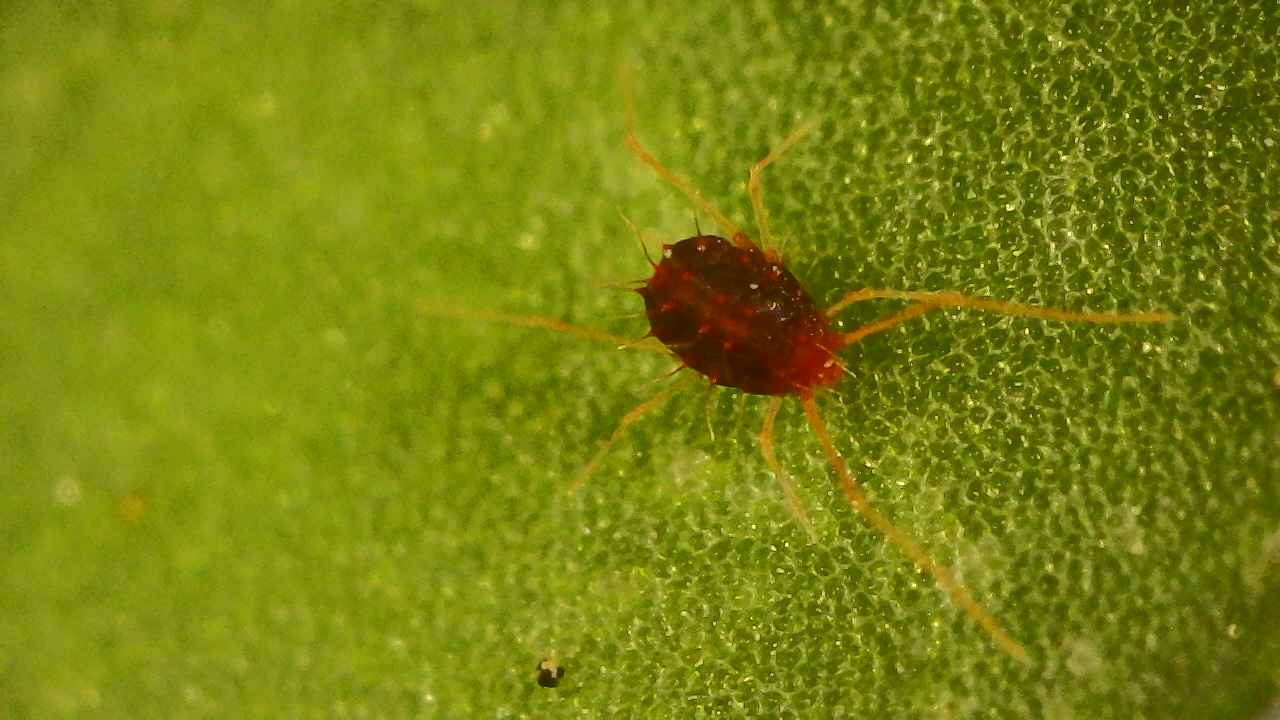
First report and life tables of Petrobia (Tetranychina) harti (Acari: Tetranychidae) on Oxalis corniculata L. (Oxalidaceae) in Tamaulipas, Mexico
DOI:
https://doi.org/10.29059/rmic.v1i2.15Keywords:
Oxalis spider mite, fecundity, longevity, demographic parameters, mortalityAbstract
Petrobia (Tetranychina) harti Ewing (Acari: Tetranychinae) is commonly known as the oxalis spider mite, as its primary hosts belong to the genus Oxalis, although it is also found in agricultural crops. In Mexico, this mite is not considered an agricultural pest, but it is in other countries. The damage caused by P. harti feeding reduces plant growth. However, little is known about its biological and demographic parameters. The objective of this study was to determine the life table parameters of P. harti on O. corniculata leaves under laboratory conditions. P. harti successfully completed its development on O. corniculata. The survival curve indicated that the risk of female death increases with age. Female fecundity and longevity were 10.33 eggs/female and 15.95 days, respectively. This resulted in an intrinsic growth rate (rm) of 0.2167. These results expand knowledge about the biological and demographic aspects of P. harti in O. corniculata.
References
Aguilar, H. & Murillo P. (2008). Nuevos hospederos y registros de ácaros fitófagos para Costa Rica: periodo 2002-2008. Agronomía Costarricense. 32: 7-28.
Baker, E. W., & Tuttle, D. M. (1994). A guide to the spider mites (Tetranychidae) of the United States. West Bloomfield, USA, Indira Publishing House. 347 pp.
Birch, L.C. (1948). The intrinsic rate of increase of an insect population. Journal of Animal Ecology. 17, 15–26.
Ben-David, T., Ueckermann, E. & Gerson, U. (2013). An annotated list of the spider mites (Acari: Prostigmata: Tetranychidae) of Israel. Israel Journal of Entomology. 43, 125–148.
Bouras, S.L. & Papadoulis, G.T. (2005). Influence of selected fruit tree pollen on life history of Euseius stipulatus (Acari: Phytoseiidae). Experimental and Applied Acarology. 36, 1–14. https://doi.org/10.1007/s10493-005-2381-5
Carey, J.R. (1993). Applied demography for biologists: with special emphasis on insects; Oxford University Press: New York, NY, USA. p. 206.
Carey, J.R. (2001). Insect biodemography. Annual Review of Entomology. 46: 79–110. https://doi.org/10.1146/annurev.ento.46.1.79
Chacón-Hernández, J.C. Ordaz-Silva, S., Osorio-Hernández, E., López-Sánchez, I.V., Neri-Ramírez, E. & Pedro-Méndez, J.G. (2025). Comparative study of the biological and life table parameters of two spider mite pest species, Tetranychus merganser Boudreaux and Oligonychus punicae Hirst (Trombidiformes: Tetranychidae), on Moringa oleifera Lam. (Moringaceae). Agriculture, 15, 700. https://doi.org/10.3390/agriculture15070700
de Lima, R. P., Bezerra, M.M., de Moraes, G. J. & Furtado, I. (2017). Life table of the red spider mite Tetranychus bastosi (Acari: Tetranychidae) on different host plants. Acarologia. 57: 601-605. https://doi.org/10.24349/acarologia/20174177
Dubitzki, E. & Gerson, U. (1987). The natural history of Petrobia (Tetranychina) harti (Ewing) and Petrobia (Mesotetranychus) tunisiae Manson (Acari: Tetranychidae) in the laboratory. Expimental and Applied Acarology. 3: 91–94. https://doi.org/10.1007/BF01270470
González-Hernández, E., Chacón-Hernández, J.C., Heinz-Castro, R.T.Q., Hernández-Juárez, A., Moreno-Ramírez, Y.d.R. & Neri-Ramírez, E. (2024). Biology and life table of Oligonychus punicae Hirst (Trombidiformes: Tetranychidae) on three host plants. Florida Entomologist. 107(1), 20230002. https://doi.org/10.1515/flaent-2023-0002
Gotoh, T. & Gomi, K. (2003). Life-history traits of the kanzawa spider mite Tetranychus kanzawai (Acari: Tetranychidae). Applied Entomology and Zoology. 38, 7–14. https://doi.org/10.1303/aez.2003.7
Groom, Q.J., Straeten, J. & Hoste, I. (2019). The origin of Oxalis corniculata L. PeerJ. 7:e6384: 1–19. https://doi.org/10.7717/peerj.6384
Hoffman, A. & López-Campos, G. (2000). Biodiversidad de los ácaros en México. Fideicomiso Fondo para la Biodiversisdad. México. 230 p.
Jain A., Barua P.T. & Bashir, M. (2010). Nutritive aspects of Oxalis corniculata L. used by tribals of Central India during scarcity of food. Journal of American Science. 6: 435–437. https://doi.org/10.7537/marsjas061110.51
Mladenovic, K., Stojnic, B., Vidovic, B., Furtula, D. & Jovic, D. (2025). First Record of Petrobia (Tetranychina) harti (Ewing, 1909) (Acari: Tetranychidae) in Serbia, with Additional Remarks. Ecologies. 6, 77. https://doi.org/10.3390/ecologies6040077
Migeon, A., Nouguier, E. & Dorkeld, F. (2010). Spider Mites Web: A comprehensive database for the Tetranychidae. Pp 557-560. In Trends in Acarology. Proceedings of the 12th International Congress. M.W. Sabelis & J. Bruin (eds.). Springer Dordrecht. Paises Bajos.
Migeon, A. & Dorkeld, F. (2026). Spider Mites Web: a comprehensive database for the Tetranychidae. Viable en https://www1.montpellier.inra.fr/CBGP/spmweb. Último acceso 02 marzo 2026
Ochoa, R., Aguilar, H. & Vargas C. (1994). Phytophagous mites of Central America: An illustrated guide. Manual Técnico, CATIE, Turrialba, Costa Rica.
Pérez-Calix, E. (2009). Oxalidaceae. Pp. 1–56. In Rzedowski, J. (ed.), Flora del Bajío y de Regiones Adyacentes, Fascículo 164. Instituto de Ecología, Veracruz, Mexico.
Pinder, J.E., Wiener, J.G. & Smith, M.H. (1978). The Weibull distribution: A new method of summarizing survivorship data. Ecology, 59, 175–179. https://doi.org/10.2307/1936645
Pritchard, A.E. & Baker, E.W. (1955). A revision of the spider mite family Tetranychidae. Memoirs series, Volume 2. Pacific Coast Entomological Society. San Francisco. California.
Puspitarini, R.D., Fernando, I., Rachmawati, R., Hadi, M.S. & Rizali, A. (2021). Host plant variability affects the development and reproduction of Tetranychus urticae. International Journal of Acarology. 47: 381–386. https://doi.org/10.1080/01647954.2021.1915377
R Core Team. (2025). R: A Language and Environment for Statistical Computing; R Foundation for Statistical Computing: Vienna, Austria. Available online: https://www.R-project.org/.
Rehman, A., Rehman, A. & Ahmad, I. (2015). Antibacterial, antifungal, and insecticidal potentials of Oxalis corniculata and its isolated compounds. International Journal of Analytical Chemistry. 2015: 842468. http://dx.doi.org/10.1155/2015/842468
Reyes-Pérez, N., Villanueva-Jiménez, J.A., de-la-Cruz-Vargas-Mendoza, M., Cabrera-Mireles, H. & Otero-Colina, G. (2013). Parámetros poblacionales de Tetranychus merganser Boudreaux (Acari: Tetranychidae) en papayo (Carica papaya L.) a diferentes temperaturas. Agrociencia. 47: 147–157.
Roy, I., Aditya, G. & Saha, G.K. (2011). Life-history features of the mite Petrobia harti (Acari: Tetranychidae) associated with Oxalis corniculata L. (Oxalidaceae). International Journal of Acarology, 37(5): 361–366. https://doi.org/10.1080/01647954.2010.519720
Sarfraz, I., Rasul, A., Hussain, G., Shah, M. A., Nageen, B., Jabeen, F., Selamoğlu, Z., UÇAK, İ., Asrar, M. & Adem, S. (2022). A review on phyto-pharmacology of Oxalis corniculata. Combinatorial Chemistry and High Throughput Screening. 25(7): 1181-1186. https://doi.org/10.2174/1386207324666210813121431
Schabenberger, O. & Pierce, F.J. (2002). Contemporary statistical models for the plant and soil sciences. CRC Press: Boca Raton, FL, USA.
Segura-Martínez, M.T.d.J., Ordaz-Silva, S., Hernández-Juárez, A., Heinz-Castro, R.T.Q., Mora-Ravelo, S.G. & Chacón-Hernández, J.C. (2023). Life table parameters of Tetranychus merganser Boudreaux (Acari: Tetranychidae) on five host plants. Insects. 14, 473. https://doi.org/10.3390/insects14050473
Siegel, S. & Castellan, N.J. (2015). Estadística no paramétrica. aplica a las ciencias de la conducta. Trillas, México.
Soler-Salcedo, E., & Ferragut, E.R. (2006). Colonización, comportamiento alimentación y producción de daños en las arañas rojas Tetranychus urticae, T. turkestani (Acari, Tetranychidae). Bolotin de Sanidad Vegetal, Plagas. 32: 523-534.
Tuttle, D.M., Baker, E.W. & Abbatiello, M.J. (1976). Spider mites of Mexico (Acari: Tetranychidae), International Journal of Acarology, 2:1-102. http://dx.doi.org/10.1080/01647957608683760Uddin, M.N., Alam, M.Z., Miah, M.R.U., Mian, M.I.H., & Mustarin, K.E. (2015). Life table parameters of Tetranychus urticae Koch (Acari: Tetranychidae) on different bean varieties. African Entomology. 23, 418–426. https://doi.org/10.4001/003.023.0231
Vaupel, J.W. (1986). How change in age-specific mortality affects life expectancy. Population Studies. 40: 147–157. https://doi.org/10.1080/0032472031000141896.
Vibrans, H. (ed.). (2009). Malezas de México. Último acceso 08 de marzo 2026. http://www.conabio.gob.mx/malezasdemexico/oxalidaceae/oxalis-corniculata/fichas/ficha.htm
Villaseñor, J.L. & Espinosa, F.J. (1998). Catálogo de malezas de México. Universidad Nacional Autónoma de México. Consejo Nacional Consultivo Fitosanitario. Fondo de Cultura Económica. México, D.F. 449 pp.
Zheng, X.-G. & Hong, X.-Y. (2007). An overview of the research on the oxalis spider mite, Tetranychina harti. Chinese Bulletin of Entomology 44: 647-651 (In Chinese with English abstract).
Zriki, G., Shaabo, A. & Boubou, A. (2015). A preliminary survey of the spider mites (Acari: Tetranychidae) in Latakia governorate of Syria. Acarologia. 55: 303–309.
Published
How to Cite
Issue
Section
License
Copyright (c) 2026 Revista Mexicana de Ingeniería y Ciencias

This work is licensed under a Creative Commons Attribution-NonCommercial 4.0 International License.